While I cannot comment on the front light, imo the GBC screen is horrible. It has a special kind of flicker, especially noticeable when you move your eyes' focus from one part of the screen to another. This is similar to the flicker on a CRT TV/monitor with a low refresh rate, or a badly designed fluorescent tube, if you're sensitive to that kind of thing. It can be just plain annoying. Your mileage may vary.
513 Jan 24, 2014 11:00 am
Re: CGB strains eyes? Will front light mod improve this? (6 replies, posted in Nintendo Handhelds)
514 Jan 24, 2014 10:53 am
Re: [SOLVED] problems uploading ROMs to Nanoloop cart (12 replies, posted in Nintendo Handhelds)
GB Pocket and GBC are using the same connector. However, I've found that using a GBP/C style link cable doesn't give the most stable connection. It can easily move to the side and lose contact if you're not careful. I personally own a link cable which has both type of connector on each end, so I can connect a DMG to a GBC, or a use the DMG connector on one side to connect to the NL adapter, which is more stable.
Are you sure that you're connecting the cable the right way around to the NL adapter? (Ie, not upside down, or randomly each time.) Which OS are you using?
I might try to do a ROM for diagnosing the problem. Do you have another working flash cartridge as well?
515 Jan 23, 2014 3:40 pm
Re: [DIY]Open-Source SD cartridge for GB/GBC (9 replies, posted in Nintendo Handhelds)
Thor17, if you use IRC, feel free to join #gbdev on EFnet.
516 Jan 23, 2014 2:11 pm
Re: [DIY]Open-Source SD cartridge for GB/GBC (9 replies, posted in Nintendo Handhelds)
If you are absolutely sure you can do it, go ahead and try. There are already two projects on the way, one by krikzz and another one by someone else, who I'll keep secret for the moment. (Not me.)
I don't mean to discourage you too much, but if you're not sure you can finish it (given your available time and skill) you may just be wasting your time. The problem for you with doing an open source project is that anyone can make copies and sell (well depending on the license, but assuming GPL) without paying you anything. The problem for anyone producing the hardware is the same, the already thin profit margins are spread even thinner if other people start producing the same hardware.
I would argue that open source works well when the development time matches the user base, ie small user base and low developer cost, and big user base and high developer cost (for example the Linux kernel, Firefox, Apache, MySQL or your favorite large OSS project.) Otherwise the risk is that the project becomes stale because of lack of development effort. This is especially pronounced in a hardware project, since hardware has a higher production cost than the electricity it takes to compile a program.
For this project, I suspect the challenge will be the SD card state machine and FAT interpreter. You want this to both work and be fast enough. And you need a bootloader somewhere that cannot be easily erased so you'll effectively brick your cart. Plus, probably, an endless list of things that need to be fixed.
Well well, enough with the discouragement rant.
517 Jan 22, 2014 8:52 pm
Re: EDIT: finally refunded :) (9 replies, posted in General Discussion)
Dogs? They only let you send bobcats, or so I've heard.
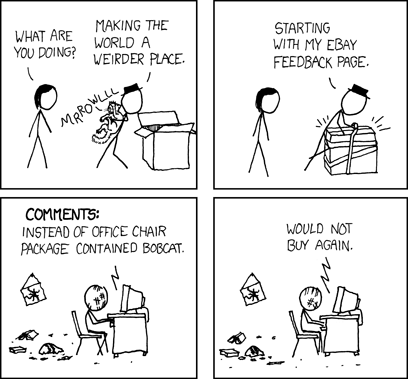
Anyway, closed.
518 Jan 22, 2014 8:45 am
Re: Arduinoboy (Arduino Pro mini) (7 replies, posted in Nintendo Handhelds)
A fake Atmega? Are you really sure about that?
519 Jan 21, 2014 2:19 am
Re: chip criminals top trumps (64 replies, posted in General Discussion)
Jose Torres, though that wasn't music crime.
520 Jan 16, 2014 10:38 am
Re: Low battery indicator for GBC or MGB? (7 replies, posted in Nintendo Handhelds)
The circuit could be modified for use with a GBC/MGB, I'm pretty sure. I personally would have done the circuit a little differently. It now connects just to the battery terminals. I would have used three terminals, ground, regulated +5V Vcc and the sense voltage. The sense voltage trigger point could then be set to something suitable for either a DMG or a GBC/MGB (something using only two 1.5 V batteries).
The problem then becomes fitting the board inside a GBC/MGB. And speaking of that, unless that board is single-sided, it could be made more space-efficient by placing components on both sides of the board. Though that might be problematic when you're going to mount it, but yeah, might be beneficial for the smaller 'boys. But this is just turning into a technical review of the batt_dmg.
You could likely not use an indicator from a GBA SP, as it's probably made using a Li ion battery charging chip which has an internal voltage reference made for that battery chemistry. This mean the threshold for a low voltage is likely set higher than the voltage of two AA/AAA, ie two AA/AAA will always detect as being low. Not to mention that it's easier to design a simple circuit from scratch than it is to reverse engineer the GBA SP's. 
Same with the GBA's, which is using AA batteries, but the indicator circuit is likely integrated into the voltage converter.
521 Jan 16, 2014 2:42 am
Re: Roland is rereleasing the 808 and 303?! (23 replies, posted in Other Hardware)
TSC wrote:
Assuming that store has the correct information. Not that I doubt it, though.
522 Jan 15, 2014 2:38 pm
Re: Got a DMG for a dollar. One big problem. (18 replies, posted in Nintendo Handhelds)
Did you understand what I meant by the resistors? Do you need an image explaining what I mean?
523 Jan 15, 2014 1:26 am
Re: Got a DMG for a dollar. One big problem. (18 replies, posted in Nintendo Handhelds)
Dirty. The solder probably rolls away because because of all that gunk. (And/or your solder or soldering iron suck.) You might be able to clean that up. But regardless, a pre-pot prosound is still viable. Just follow the signals back a tiny bit. you'll find that the pre-pot signal points connect to two resistors next to each other, one for each channel. If you can solder to any point there you might be good to go. You could also try on the top side, by soldering the signal wires directly to the resistors. If you do this, and nothing is shorted out on the dirty side, you should have a working prosound.
524 Jan 12, 2014 11:25 am
Re: guys, the golden dmg is right here: (3 replies, posted in General Discussion)
Alley Beach wrote:
whats up with that lion king product pic... this guy...
Someone made it to ridicule hime, and I guess he's taking pride in that notoriety.
And sorry, shawn. This was fun while it lasted. Let's now move on.
525 Jan 10, 2014 5:29 pm
Re: Game Boy Original 1989 Custom Painted Clear/Gold!! Backlight! NES!!! (143 replies, posted in Trading Post)
One day you're going to look back at this thread and think to yourself that it was pretty silly. Until then, farewell, thread!
526 Jan 9, 2014 10:44 am
Re: Game Boy Original 1989 Custom Painted Clear/Gold!! Backlight! NES!!! (143 replies, posted in Trading Post)
infradead wrote:
boaconstructor wrote:very rare. so desirable. wow
Fuck now I want a doge DMG.
This hereby officially only allowed if you pay for it with Dogecoin.
527 Jan 9, 2014 1:31 am
Re: Game Boy Original 1989 Custom Painted Clear/Gold!! Backlight! NES!!! (143 replies, posted in Trading Post)

I'm trying to figure out for myself whether shawn's primary intention was to troll that guy or cm.o.
528 Jan 7, 2014 2:16 pm
Re: Introducing ALTANE, nitro2k01's cartridge flasher project (170 replies, posted in Nintendo Handhelds)
Timbob wrote:
I got a NL 1.0 cart you could test

Before possibly wasting your time/money, could you please look inside, take a photo of the board, and note what is written on the chips that are on there?
Timbob wrote:
And, farfetched idea: could it also write eprom carts? I got a few weird ones
Unfortunately, the short answer is no. EPROM chips typically require a high voltage (around 12V, compared to the 5V for that the GB is using.) to be present, and that has to be generated somehow. Aside from the practical difficulty of doing this (This might be done with an extra adapter board sitting between the flasher and the cart containing a voltage boost circuit for example.) it might be impossible to this programming in-place on the cartridge. For example, the programming pin may not be routed to the cartridge connector, or it may be shared with one of the other pins, and connected in parallel with the memory bank controller chip in such a way that the MBC would be destroyed.